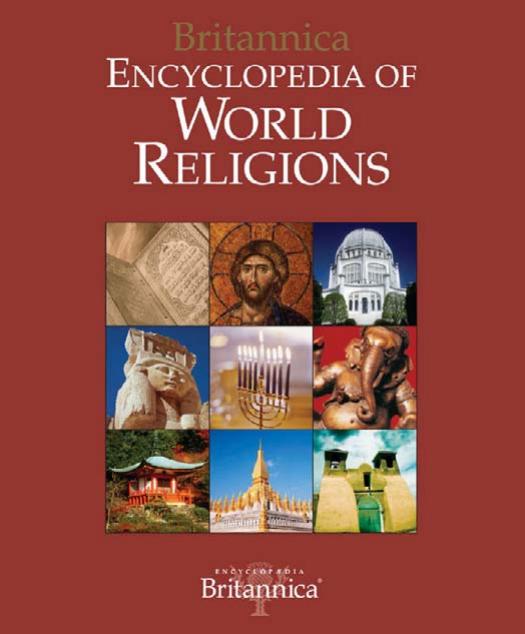
Britannica Encyclopedia of World Religions by Unknown
Author:Unknown
Language: eng
Format: epub, pdf
that “second Torah” and produced not merely counterpart exegeses to those of
the Christians but counterpart compilations of such exegeses as well.
Symbol. As the generative symbol of the literary culture of the sages, the To-
rah stands for the system of Rabbinic Judaisms as a whole. The Torah was sym-
bolic of the doctrine that Moses received the Torah at Mount Sinai in two media,
written and oral. The written Torah was transmitted and is now contained in the
Pentateuch. The oral Torah was formulated for ease in memorization and then
transmitted through sages and their disciples, from Moses and Joshua to the most
current generation of rabbis today.
That doctrine of the dual Torah, that is, of the Torah in two media, came about
in response to the problem of explaining the standing and authority of the Mish-
nah. But broadening the symbol of the Torah was actually accomplished around
the figure of the sage. The symbol of the Torah accounted for the sages’ authori-
ty—the sage being the one in possession of God’s oral law. Only later on in the
pages of the Talmud Yerushalmi did the doctrine of the dual Torah reach expres-
sion. So in the evolution of the documents of the canon of Judaism, the generative
symbol of Torah reveals a striking change. Beginning as a rather generalized ac-
count of how sages’ teachings relate to God’s will, the symbol of Torah gained
concrete form in its application to the dual Torah, written and oral, Pentateuch
and Mishnah. What once stood for a few specific books came to stand for all the
teachings and laws of Israel, as well as the system that taught and promulgated
those laws.
Torah thus took on a multiplicity of meaning: standing for a kind of human be-
ing, connoting a social status and group, and referring to a type of social relation-
ship. It further came to denote a legal status, differentiating things and persons,
actions and status, as well as “revealed truth.” In all, the main points of insis-
tence of the whole of Israel’s life and history come to full symbolic expression in
that single word. If people wanted to explain how they would be saved, they
would use the word Torah. Torah stood for salvation and accounted for Israel’s
this-worldly condition and the hope, for both individual and nation alike, of life
in the world to come. For the kind of Judaism under discussion, therefore, the
word Torah stood for everything, symbolizing at once the whole.
After the appearance of the Mishnah, the Torah moved, in two significant stag-
es, from standing for a concrete, material object, a scroll, to symbolizing a broad
range of relationships. The first stage is marked off by tractate Abot, the second
by the Talmud Yerushalmi. As to the former, Abot regards the study of Torah as
what a sage does, while the substance of Torah is what a sage says, and likewise
what a sage says falls into the classification of Torah. At issue in Abot is not To-
rah but the authority of the sage. It is the sage’s standing that transforms a saying
into a Torah-saying, placing it into the classification of Torah. Abot then stands
Download
Britannica Encyclopedia of World Religions by Unknown.pdf
This site does not store any files on its server. We only index and link to content provided by other sites. Please contact the content providers to delete copyright contents if any and email us, we'll remove relevant links or contents immediately.
Whiskies (Collins Gem) by dominic roskrow(45527)
Spell It Out by David Crystal(36237)
Cecilia; Or, Memoirs of an Heiress — Volume 1 by Fanny Burney(32720)
Cecilia; Or, Memoirs of an Heiress — Volume 2 by Fanny Burney(32088)
Cecilia; Or, Memoirs of an Heiress — Volume 3 by Fanny Burney(32065)
Beautiful Disaster by McGuire Jamie(25452)
Trainspotting by Irvine Welsh(21971)
Chic & Unique Celebration Cakes by Zoe Clark(20149)
The Secret History by Donna Tartt(19469)
How High Can a Kangaroo Hop? by Jackie French(18843)
Twilight of the Idols With the Antichrist and Ecce Homo by Friedrich Nietzsche(18775)
All the Missing Girls by Megan Miranda(16697)
Cat's cradle by Kurt Vonnegut(15555)
Ready Player One by Cline Ernest(15139)
For the Love of Europe by Rick Steves(14907)
Fifty Shades Freed by E L James(13349)
4 3 2 1: A Novel by Paul Auster(12611)
Crooked Kingdom: Book 2 (Six of Crows) by Bardugo Leigh(12453)
Grundlagen Kreatives Schreiben (German Edition) by Helfferich Pia(10522)
